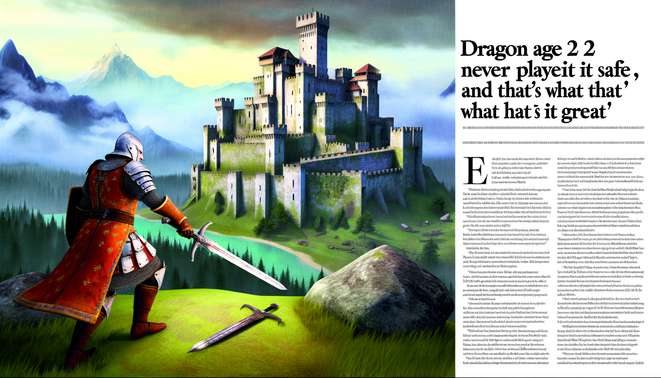
There are many staples that make up a BioWare game. You have your legendary hero, one that you can shape to your liking with different background options. Next is your singular big bad, a gigantic, evil dragon or maybe an advanced machine race destined to wipe out all life in the galaxy. But the most important part of all: the chance at a happy ended earned through trial and tribulation.
Yet, amidst this well-established formula, one particular entry in the BioWare canon dared to deviate significantly, to push boundaries and challenge player expectations: Dragon Age II. Released in 2011, it arrived after the critically acclaimed Dragon Age: Origins and was met with a polarized reception. Many felt it was a step backward, an unfinished product rushed to market. But looking back, over a decade later, it’s clear that Dragon Age II never played it safe — and that, ultimately, is precisely what made it great.
The Hero of Kirkwall, Not a Blank Slate
In Dragon Age: Origins, you crafted your Warden from the ground up: human noble, city elf, dwarf commoner, mage, rogue, warrior – the choices were vast and foundational to your experience. Dragon Age II flipped this on its head. Instead of a silent protagonist you imbued with personality, you played as Hawke, a pre-defined human refugee with a specific surname and, perhaps most controversially at the time, a fully voiced protagonist.
This was a radical departure. Hawke wasn’t a blank slate; they were a person with a family (mother Leandra, siblings Bethany and Carver), a history, and an inherent sarcastic, diplomatic, or aggressive personality that shone through their dialogue options. While some players yearned for the total freedom of Origins, Hawke’s defined personality allowed for more nuanced character interactions and a deeper sense of connection to their personal journey. It made Hawke feel like a living, breathing character, reacting to events with genuine emotion, rather than a vessel for player choice alone. This bold move laid groundwork for future BioWare protagonists, proving that a defined voice could enhance, rather than diminish, role-playing.
Kirkwall: A City, Not a Continent
BioWare games often whisk players away on epic, world-saving quests across sprawling continents. Dragon Age II confined its narrative almost entirely to the bustling, often oppressive city of Kirkwall and its immediate environs. This wasn’t a world-spanning adventure; it was a character study of a city teetering on the brink of civil war, viewed through the eyes of one family.
This narrow focus allowed for an unprecedented depth in environmental storytelling and character development. Kirkwall itself became a character – a dark, complex, and unforgiving place shaped by refugee crises, racial tensions between Qunari and native Kirkwall residents, and the ever-escalating conflict between the Mages and the Templars. Players weren’t saving the world; they were navigating the turbulent waters of urban politics and social unrest. This localized approach allowed for a more intimate, grittier narrative, highlighting the consequences of actions within a contained, believable ecosystem, rather than a generic ‘save the world’ trope.
A Decade in the Life of Hawke
Another significant departure was the game’s timeline. Instead of a single, continuous epic, Dragon Age II unfolds over a decade, narrated by Varric Tethras. This episodic structure, divided into three acts, allowed players to witness the gradual erosion of peace in Kirkwall, the slow-burning escalation of tensions, and the profound changes in Hawke and their companions over time. Characters aged, alliances shifted, and the city itself transformed under the weight of its internal conflicts.
This narrative daring provided a refreshing change of pace. It wasn’t about defeating a singular ‘big bad’ at the end of a linear quest. Instead, it was about living through a period of immense change, making choices with long-term repercussions, and watching those consequences ripple through years. This approach deepened the emotional impact of the story, as players saw the slow descent into chaos, making the eventual climactic conflict feel earned and inevitable.
Companions: Flawed, Complex, and Unforgettable
BioWare excels at creating memorable companions, but Dragon Age II took this to another level. The companions in Dragon Age II weren’t just sidekicks; they were integral to the unfolding drama of Kirkwall, often wrestling with their own profound moral ambiguities and personal demons. Anders’ tragic transformation from a roguish spirit healer to a radicalized revolutionary, Merrill’s unwavering pursuit of forbidden blood magic, or Isabela’s journey from self-serving pirate to a fiercely loyal friend – these character arcs were some of the richest and most challenging in BioWare’s history.
The game didn’t shy away from depicting the messy, often heartbreaking realities of living in a city on the brink. Your companions weren’t always ‘good’ or ‘bad’; they were deeply human (or elven/qunari/dwarven) characters caught in impossible situations. This level of moral greyness and character evolution was a testament to the game’s willingness to explore complex themes and push narrative boundaries, fostering a deeper, more emotionally resonant connection between the player and their party.
Combat: Fast, Fluid, and Polarizing
Perhaps the most immediately noticeable ‘safe’ choice Dragon Age II abandoned was its combat system. Moving away from the tactical, pause-and-play combat of Origins, DA2 embraced a faster, more action-oriented style, especially on consoles. While still retaining some tactical depth, it felt more fluid, almost like a hack-and-slash at times, with flashy animations and quicker engagements.
This change was a major point of contention among fans. Many Origins veterans missed the slower, more deliberate strategy. However, for a broader audience, and perhaps for BioWare looking to streamline and modernize, this shift was deliberate. It made combat feel more impactful and immediate, contributing to the game’s overall faster pace. It was a risk taken to appeal to a wider demographic and simplify the gameplay loop, even if it alienated some long-time players. It signaled BioWare’s willingness to experiment even with core gameplay mechanics.
The Legacy: A Reappraisal
Upon its release, Dragon Age II was criticized for reused environments, a rushed development cycle, and the very narrative choices that make it unique today. Yet, with time and distance, its reputation has steadily improved. What was once seen as a flaw – its limited scope, its defined protagonist, its episodic nature – is now often heralded as its strength.
It proved that a BioWare RPG didn’t need to be about a grand, world-ending threat to be compelling. It demonstrated that focusing on character development, political intrigue, and the slow burn of social conflict could yield a more personal and emotionally impactful story. Dragon Age II served as an important stepping stone, influencing later BioWare titles and demonstrating that innovation, even when initially met with resistance, can lead to a richer, more diverse storytelling landscape in gaming.
Conclusion
Dragon Age II arrived at a time when expectations for BioWare RPGs were perhaps at their peak, and its bold departures from the established formula were jarring for many. It wasn’t the sweeping epic players anticipated, but something far more personal, more focused, and ultimately, more daring. By embracing a defined protagonist, a contained setting, an extended timeline, and morally complex companions, Dragon Age II carved out a unique and unforgettable niche in the fantasy RPG genre. It challenged players to accept a different kind of hero, a different kind of conflict, and a different kind of storytelling. In its refusal to play it safe, Dragon Age II didn’t just tell a great story; it proved that true greatness often lies in the courage to defy expectations and forge a path less traveled. It remains a testament to BioWare’s enduring willingness to experiment, and a cult classic for those who appreciate its audacious spirit.


