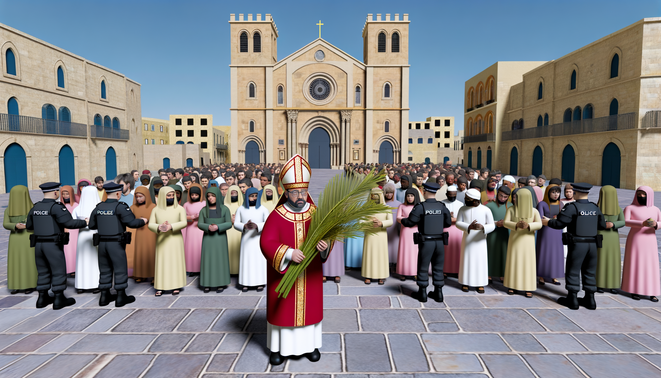
Jerusalem, a city revered by billions worldwide, often finds itself at the epicenter of spiritual devotion and geopolitical complexities. For Christians, Palm Sunday marks the poignant beginning of Holy Week, commemorating Jesus Christ’s triumphant entry into Jerusalem before his crucifixion. It is a day of vibrant processions, fervent prayer, and deep spiritual significance. Yet, in a deeply concerning turn of events, the 2023 Palm Sunday celebrations in Jerusalem were overshadowed by an incident that sparked international outcry: Israeli police blocking the Latin Patriarch, Cardinal Pierbattista Pizzaballa, from reaching the traditional Palm Sunday mass in the Old City.
This unprecedented obstruction of one of the highest-ranking Christian leaders in the Holy Land has not only cast a pall over the solemnity of the occasion but has also reignited critical debates surrounding religious freedom, the delicate “Status Quo” governing Jerusalem’s holy sites, and the challenging realities faced by Christian communities in the region. For beginners and intermediate readers alike, understanding this event requires delving into its historical context, the specifics of what transpired, and the far-reaching implications it carries for interfaith relations and the future of religious observance in this sacred city.
The Sacred Tapestry of Palm Sunday in Jerusalem
Palm Sunday is much more than just a religious observance; it is a vivid reenactment of a pivotal moment in Christian scripture. According to the Gospels, Jesus entered Jerusalem riding a donkey, where he was greeted by crowds waving palm branches and laying cloaks before him, shouting “Hosanna to the Son of David!” This act symbolized peace and humility, a stark contrast to the military might often associated with triumphant entries. In Jerusalem, this tradition has been observed for centuries with a grand procession, typically starting from the Mount of Olives and proceeding into the Old City, culminating in worship at the Church of the Holy Sepulchre or other significant churches.
For the Christian faithful in Jerusalem, this procession is a powerful public display of faith, connecting them directly to the events of two millennia ago. It is a moment of communal identity and spiritual renewal, drawing pilgrims and local Christians together in a shared expression of devotion. The Latin Patriarch, as the highest-ranking Roman Catholic prelate in the region, traditionally leads this significant procession, symbolizing the continuity and leadership of the Catholic Church in the very cradle of Christianity.
The Unsettling Incident: What Unfolded on Palm Sunday 2023
On April 2, 2023, as the Latin Patriarch, Cardinal Pierbattista Pizzaballa, attempted to access the traditional Palm Sunday procession route near the Jaffa Gate of Jerusalem’s Old City, he and his accompanying clergy were met by Israeli police officers who blocked their passage. Videos and eyewitness accounts circulated widely, showing the Cardinal attempting to reason with officers, explaining his identity and purpose, only to be physically held back. The scene was one of confusion and visible distress, with the Cardinal expressing frustration at the impediment to his religious duties.
According to reports from the Latin Patriarchate, the police cited “security reasons” and “crowd control” as justifications for their actions. However, the Patriarchate and many observers countered that such restrictions were unprecedented for a religious leader of his stature on such a significant day, especially given the historical precedents of these processions. While some smaller processions were allowed to proceed, the obstruction of the Patriarch himself sent a clear and disturbing message about the perceived challenges to Christian religious freedom in the Holy City. The incident highlighted a growing tension between Israeli authorities and Christian communities, who often feel their rights and access to holy sites are being increasingly encroached upon.
Understanding the Context: Religious Freedom and the ‘Status Quo’
To fully grasp the gravity of this incident, one must understand the delicate balance of religious affairs in Jerusalem, particularly the concept of the “Status Quo.” This unwritten understanding, largely established during the Ottoman era and maintained under British, Jordanian, and now Israeli rule, governs access and control over various Christian, Muslim, and Jewish holy sites. It aims to prevent conflicts by preserving the existing rights and customs of different religious communities.
The Latin Patriarch’s obstruction directly challenges this Status Quo, which implicitly guarantees the freedom of worship and unimpeded access for religious leaders to their respective holy sites, especially on major feast days. Christian leaders have repeatedly voiced concerns that these long-standing arrangements are being eroded, with increasing restrictions on movement, pilgrim numbers, and even the ability to perform traditional religious ceremonies. These concerns are not new, but incidents like the one on Palm Sunday escalate anxieties and call into question the commitment of authorities to uphold established agreements and ensure the rights of all religious communities.
Waves of Reaction and Condemnation
The blocking of Cardinal Pizzaballa immediately drew sharp condemnation from various quarters. The Latin Patriarchate issued a strong statement, denouncing the actions as a violation of religious freedom and an unacceptable affront to the Christian community. Other Christian denominations in Jerusalem, including Greek Orthodox and Armenian Orthodox leaders, quickly expressed solidarity and echoed concerns about the erosion of Christian rights in the Holy Land. The incident was seen not merely as an isolated event but as part of a broader pattern of restrictions affecting Christians.
Internationally, the Vatican expressed deep concern, with calls from various diplomatic channels for respect for religious freedom and the Status Quo. Human rights organizations and interfaith dialogue groups also weighed in, highlighting the importance of protecting the sanctity of religious observances and ensuring unhindered access to holy sites for all faiths. Israeli authorities, while defending their actions as necessary for public safety and order, faced mounting pressure to address the underlying concerns raised by the Christian community and the international body. The global media extensively covered the story, bringing the plight of Jerusalem’s Christians into sharper focus.
Implications for Christian-Israeli Relations and Beyond
The Palm Sunday incident carries significant implications for the already complex relationship between Christian communities and Israeli authorities. It has deepened feelings of vulnerability and marginalization among Christians in the Holy Land, who constitute a small but historically vital population. The event underscores a persistent fear that their presence and traditions are being increasingly sidelined amid the broader political and religious landscape of Jerusalem.
Beyond local dynamics, the incident reverberates globally, influencing how the world perceives Israel’s commitment to religious pluralism and freedom of worship. For many, Jerusalem is not just a capital but a global spiritual heritage. Any perceived threat to the freedom of its religious communities raises international concern and can impact diplomatic relations. The episode serves as a stark reminder of the fragile coexistence in Jerusalem and the constant need for dialogue, mutual respect, and adherence to established protocols to prevent further tensions and ensure that all faiths can practice their traditions without impediment.
Upholding Sacred Rights in a Sacred City
The blocking of the Latin Patriarch on Palm Sunday 2023 was a deeply troubling event that sent shockwaves through the Christian world and beyond. It was a moment that underscored the profound sensitivities surrounding religious freedom and access to holy sites in Jerusalem, a city brimming with spiritual significance for billions. While security concerns are undoubtedly valid in any major urban center, especially one as politically and religiously charged as Jerusalem, they must never come at the cost of fundamental religious rights and established traditions.
The incident serves as a critical call to action for all stakeholders. It highlights the urgent need for renewed dialogue, a steadfast commitment to upholding the historical Status Quo, and a clear recognition of the importance of ensuring that all religious communities in Jerusalem can practice their faith freely and without obstruction. For the sacred city of Jerusalem to truly embody its universal spiritual calling, it must be a place where the paths to prayer and peace remain open for everyone, always.


