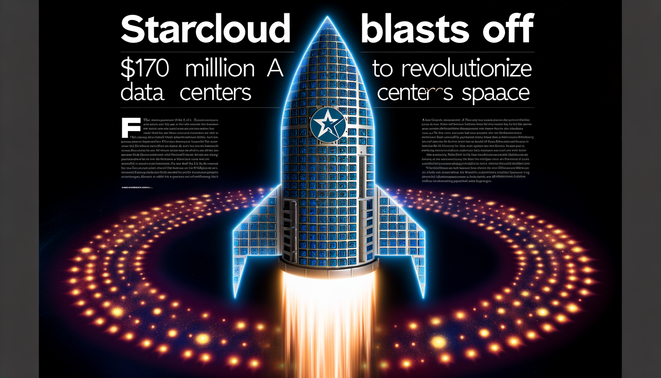
Starcloud Blasts Off: $170 Million Series A to Revolutionize Data Centers in Space
The final frontier isn’t just for astronauts and telescopes anymore. It’s increasingly becoming the new battleground for data. In a monumental leap for technology and space exploration, Starcloud, an ambitious startup, has just secured a staggering $170 million in Series A funding. Their mission? To build and operate the world’s first true data centers in orbit. This isn’t science fiction; it’s the audacious next chapter in cloud computing, promising to reshape how we store, process, and secure information.
For decades, data centers have been the quiet giants powering our digital world, humming away in climate-controlled facilities on Earth. But as our global data footprint explodes and the demand for instant, secure, and resilient computing grows, the limitations of terrestrial infrastructure are becoming apparent. Starcloud’s audacious vision offers a celestial solution, pushing the boundaries of what’s possible and opening up an entirely new dimension for digital infrastructure.
Why Move Data Centers to Space? The Orbital Advantage
At first glance, the idea of sending massive computing infrastructure into orbit might seem extravagant. However, a closer look reveals compelling advantages that could revolutionize several industries:
- Unprecedented Security: Placing data centers in space naturally provides an extreme level of physical security. Orbital facilities are inherently difficult to access, significantly reducing risks from terrestrial physical attacks, natural disasters, or geopolitical instability. Data could reside in a digital fortress orbiting hundreds of miles above Earth.
- Reduced Latency for Specific Applications: While it might seem counterintuitive, for certain types of data transfer, especially across vast distances or to remote locations, space-based data centers could offer lower latency. By being closer to satellite communication networks, they can bypass extensive ground infrastructure, speeding up critical operations for applications like global financial trading, remote sensing, and military communications.
- Abundant, Sustainable Power: In space, solar power is virtually limitless and uninterrupted for much of an orbit. Data centers could harness constant solar energy, significantly reducing their carbon footprint compared to ground-based facilities that often rely on fossil fuels. This offers a compelling pathway towards truly green computing.
- Superior Cooling: The vacuum of space offers an incredible environment for passive cooling. While active cooling systems would still be required, the lack of atmospheric heat transfer makes it easier to dissipate waste heat, potentially leading to more energy-efficient operations and higher performance for processing units.
- Disaster Recovery and Resilience: Orbiting data centers could provide an ultimate form of disaster recovery. In the event of widespread terrestrial outages or catastrophes, critical data and services could remain operational and accessible from space, ensuring unparalleled resilience for governments, businesses, and essential services.
The Engineering Marvel: How Starcloud Plans to Build in Orbit
Building data centers in space isn’t just about launching a server rack. It’s a monumental engineering challenge requiring innovation across multiple disciplines:
Modular Design and Launch
Starcloud envisions a modular approach, where individual “data modules” or “server satellites” are launched and then assembled or networked in orbit. This strategy reduces the risk and cost associated with launching a single, massive structure. Each module would be self-contained, equipped with its own power, cooling, processing, and communication capabilities.
Powering the Orbital Giants
Solar arrays will be the primary power source, constantly orienting themselves towards the sun. Advanced battery technology will store energy for periods of eclipse. The sheer scale will require robust power management systems capable of handling significant loads.
Radiation Hardening and Protection
Space is a harsh environment, bombarded by cosmic radiation and solar flares. Starcloud’s hardware will need to be specially designed and shielded (“radiation-hardened”) to withstand these conditions, ensuring data integrity and operational longevity. This involves selecting specific components and employing robust error correction techniques.
High-Bandwidth Communication
Connecting these orbital data centers to users on Earth requires cutting-edge communication systems. Starcloud will likely leverage laser communication (optical links) in addition to traditional radio frequencies, offering ultra-high bandwidth and secure data transfer rates to ground stations or other satellite networks.
Automated Operations and Maintenance
With human intervention being extremely costly and complex in space, these data centers will need to be highly autonomous. AI and robotics will play a crucial role in monitoring performance, conducting diagnostics, performing repairs, and managing resources without constant human oversight.
Starcloud’s Vision: A New Era of Secure, Resilient Computing
The $170 million Series A funding will fuel Starcloud’s ambitious roadmap. This capital will be used to:
- Accelerate R&D: Further develop radiation-hardened components, advanced cooling systems for vacuum environments, and robust autonomous operational software.
- Prototype Development and Testing: Build and test initial satellite prototypes, demonstrating key technologies in lower Earth orbit (LEO).
- Expand Engineering Teams: Recruit top talent in aerospace engineering, satellite technology, cloud infrastructure, and AI.
- Launch Initial Fleet: Fund the manufacturing and launch of the first operational data center modules, establishing foundational orbital infrastructure.
Starcloud isn’t just building servers in space; they’re creating a new paradigm for cloud services. Imagine government agencies securing classified data in an unassailable orbital vault, financial institutions executing ultra-low-latency trades globally, or researchers processing vast datasets from remote sensing satellites directly in orbit, bypassing slow terrestrial downlinks. This is the future Starcloud aims to deliver.
The Broader Impact: Reshaping Industries and the Space Economy
The implications of Starcloud’s success extend far beyond merely storing data. This venture could:
- Boost the Space Economy: It adds a critical layer of infrastructure to the burgeoning space economy, creating demand for launch services, satellite manufacturing, and ground support operations.
- Empower Remote Regions: By providing data processing capabilities directly from orbit, it could bring advanced computing closer to underserved regions on Earth that lack robust terrestrial infrastructure.
- Advance Scientific Research: Scientists could process massive amounts of satellite imagery and experimental data directly in space, accelerating discoveries in climate science, astronomy, and Earth observation.
- Strengthen National Security: Governments could gain unparalleled data security and resilience for critical defense and intelligence operations, independent of terrestrial vulnerabilities.
- Drive AI and Edge Computing: Processing data closer to its source (in this case, other satellites or remote terrestrial sensors) is crucial for real-time AI applications and advanced edge computing, leading to faster insights and decision-making.
Navigating the Challenges: A Clear-Eyed View
While the prospects are exciting, Starcloud’s journey is not without significant hurdles:
- Launch Costs: Though declining, launching payloads into space remains expensive. Starcloud’s modular approach aims to mitigate this by optimizing payload mass and leveraging advancements in reusable rocket technology.
- Space Debris: Operating a fleet of data centers in orbit adds to the already pressing issue of space debris. Starcloud will need to implement robust collision avoidance systems and adhere strictly to international guidelines for sustainable space operations, including de-orbiting at end-of-life.
- Regulatory Frameworks: The legal and regulatory landscape for commercial operations in space, especially regarding data sovereignty and security, is still evolving. Starcloud will need to work closely with international bodies and national governments.
- Maintenance and Upgrades: Performing repairs or upgrades in orbit is vastly more complex than on Earth. The reliance on automation and long-lifespan components will be paramount.
Conclusion: Starcloud – A Giant Leap for Data Kind
Starcloud’s $170 million Series A funding isn’t just an investment in a company; it’s an investment in the future of data, the future of space, and the future of human ingenuity. By envisioning data centers beyond our atmosphere, they are tackling some of the most critical challenges facing our digital world – security, sustainability, and resilience. This bold venture promises to unlock unprecedented capabilities, drive innovation across countless sectors, and solidify space as the next frontier for technological advancement.
As Starcloud begins its journey to build these celestial digital fortresses, we stand on the cusp of a new era. An era where the cloud isn’t just a metaphor for distributed computing, but a literal reality among the stars.


